
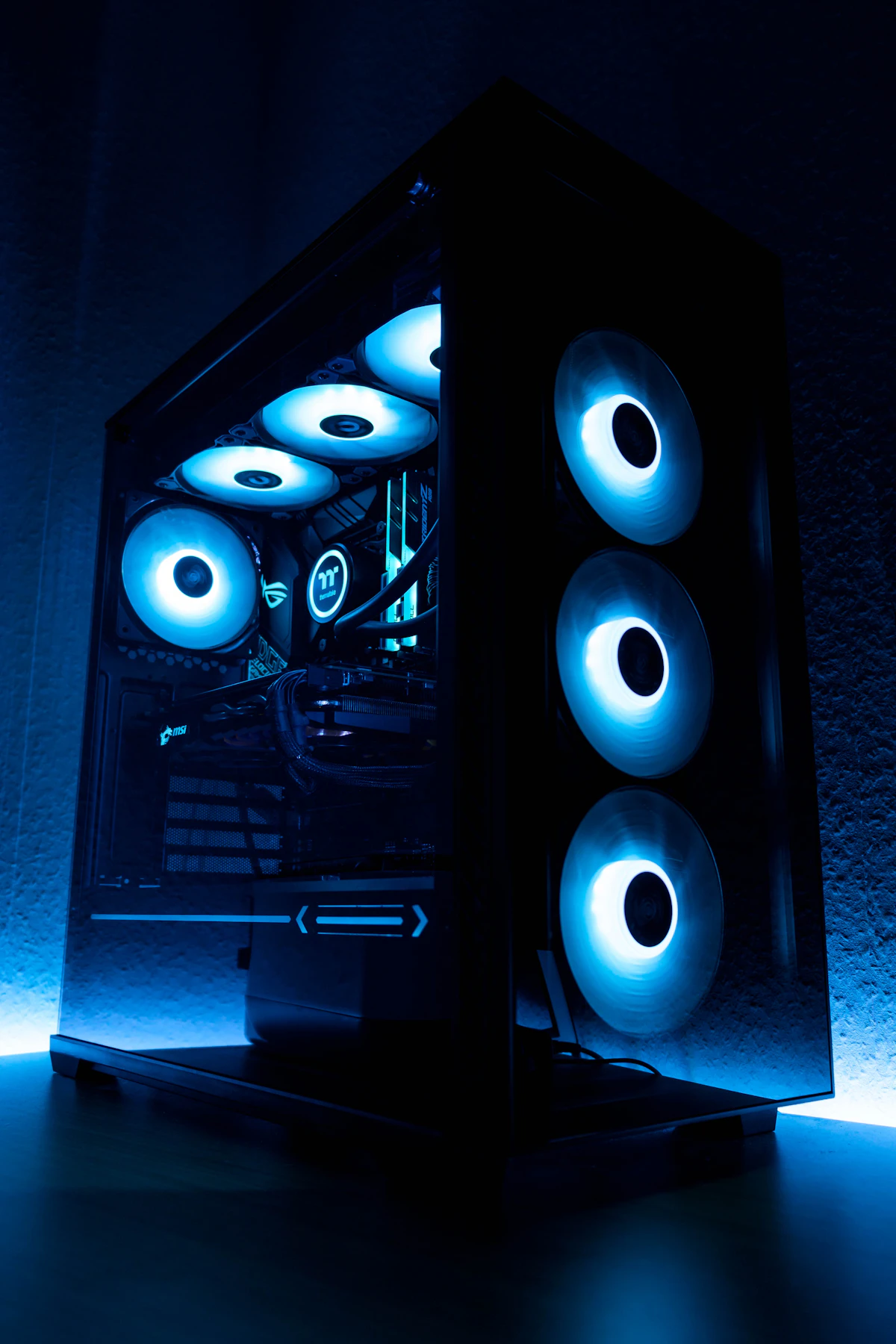
Understanding Graphics Cards: NVIDIA vs AMD
The graphics processing unit (GPU) is the undisputed powerhouse of any modern gaming and content creation PC. It is also the single most expensive component in your setup, often accounting for 40% to 50% of an entire system’s total budget.
For years, the desktop graphics card market has been defined by the epic technological rivalry between NVIDIA GeForce and AMD Radeon.
Should you pay a premium for NVIDIA’s state-of-the-art Ray Tracing cores and AI-driven DLSS frame generation? Or should you invest in AMD’s high-capacity VRAM configurations and superior raw rasterization performance-per-dollar?
In this architectural guide, our hardware lab analyzes silicon architectures, upscaling algorithms, Ray Tracing efficiency, and the critical importance of video memory.
Architectural Showdown: Ada Lovelace vs RDNA 3
| Architectural Pillar | NVIDIA GeForce (RTX 40 & 50 Series) | AMD Radeon (RX 7000 & 8000 Series) | Clear Winner |
|---|---|---|---|
| Silicon Architecture | Monolithic Die on TSMC 4N process | Modular Chiplet Design (GCD + MCDs) | NVIDIA (Energy efficiency) / AMD (Manufacturing cost) |
| Raw Traditional Rasterization | High performance; premium price tier | Exceptional performance-per-dollar | AMD Radeon |
| Hardware Ray Tracing | 3rd/4th Gen RT Cores with Opacity Micromaps | 2nd/3rd Gen Ray Accelerators | NVIDIA (By a 30%–50% margin) |
| AI Upscaling Quality | DLSS 3.5 (Tensor Core AI hardware) | FSR 3.1 (Spatial/Temporal software math) | NVIDIA DLSS (Class-Leading) |
| Video Memory (VRAM) per Dollar | Conservative (8GB – 16GB standard) | Generous (16GB – 24GB widely available) | AMD Radeon |
| Content Creation / 3D Rendering | Industry standard (CUDA, OptiX, NVENC) | OpenCL, ROCm, AV1 hardware encoding | NVIDIA |

1. Traditional Rasterization: AMD’s Value Stronghold
For traditional rasterized games—titles that rely on conventional rendering techniques without heavy ray tracing—AMD Radeon graphics cards deliver devastating performance-per-dollar value:
- The AMD Radeon RX 7800 XT routinely matches or beats the pricier NVIDIA RTX 4070 in 1440p rasterized benchmarks, while costing approximately $50 to $80 less.
- AMD accomplishes this through its innovative Chiplet Architecture, decoupling the core Graphics Compute Die (GCD) from smaller Memory Cache Dies (MCDs). This dramatically reduces silicon manufacturing defects and allows AMD to pass savings directly to consumers.
2. Ray Tracing and Path Tracing: NVIDIA’s Technological Chasm
When you toggle Ray Tracing or Full Path Tracing on in cutting-edge graphical showpieces like Cyberpunk 2077, Alan Wake 2, or Black Myth: Wukong, the performance dynamic shifts radically in NVIDIA’s favor.
Why NVIDIA Dominates Ray Tracing:
- Dedicated Hardware Cores: NVIDIA’s 3rd and 4th Gen RT Cores offload the mathematically brutal BVH (Bounding Volume Hierarchy) ray-triangle intersection traversal entirely from the main shader cores.
- Shader Execution Reordering (SER): Intelligently reorganizes chaotic, diverging ray-tracing workloads into organized, execution-friendly thread blocks on the fly.
- In heavy ray-tracing scenarios, an NVIDIA card frequently outputs 35% to 60% higher frame rates than its direct AMD competitor.

3. The Upscaling War: DLSS vs FSR vs XeSS
Modern games are so computationally demanding that rendering them at native 4K resolution is often inefficient. Instead, modern GPUs render internally at 1440p and employ machine-learning upscalers to reconstruct a crisp 4K output image.
NVIDIA DLSS (Deep Learning Super Sampling)
DLSS leverages dedicated silicon Tensor Cores to feed motion vectors and historical frame buffers through a convolutional neural network trained on millions of supercomputer images. The result is astonishing: DLSS Quality mode frequently looks sharper and more stable than native resolution rendering, completely eliminating temporal shimmer on distant fences and powerlines.
AMD FSR (FidelityFX Super Resolution)
FSR is an open-source, non-AI algorithm that runs across any GPU brand (including NVIDIA and Intel cards). While FSR 3 has improved significantly, it still exhibits faint ghosting artifacts, shimmering foliage, and slightly softer edge reconstruction compared to DLSS.
4. The VRAM Crisis: Why 8GB Is Obsolete
One of NVIDIA’s most criticized decisions has been stingy VRAM allocations on entry and mid-tier cards (such as equipping $400 graphics cards with only 8GB of VRAM).
Modern AAA games utilizing high-resolution 4K textures, ray-tracing BVH tables, and frame generation easily consume 10GB to 14GB of video memory at 1440p. When a graphics card exhausts its physical VRAM buffer:
- The system must stream texture assets across the PCIe bus from system RAM.
- Frame rates instantly crater, leading to catastrophic stuttering, unrendered muddy textures, and game crashes.
- AMD’s decision to equip mid-tier cards with 16GB of VRAM as a baseline provides significantly greater multi-year insurance against obsolescence.
Summary Buying Recommendation
- Choose NVIDIA GeForce if: You want to play the newest graphical showcases with maximum Ray Tracing and Path Tracing, value superior DLSS image quality and Frame Generation, stream on Twitch using the NVENC video encoder, or work in 3D modeling (Blender), video production (Premiere), and local AI machine learning.
- Choose AMD Radeon if: You prioritize raw traditional rasterized gaming performance-per-dollar, want generous 16GB+ VRAM capacities that guarantee smooth texture streaming for years to come, and play predominantly on Linux where AMD’s open-source drivers reign supreme.


